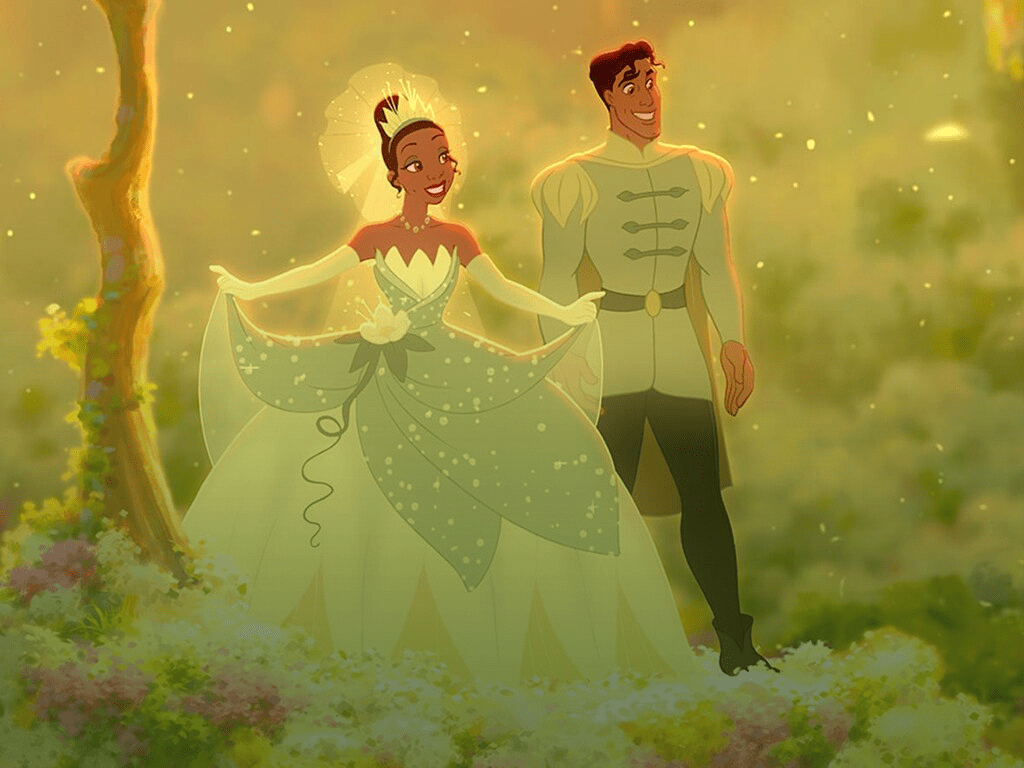
Picture from Disney Movies official website
The Princess and the Frog is directed by Ron Clements and John Musker, the same duo behind Disney classics like The Little Mermaid (1989) and Aladdin (1992). The music is composed by Randy Newman, featuring a jazzy soundtrack full of energy, heart, and southern soul. In 2010, this film was nominated for “Best Feature Film” and got two more Oscar nominations for Original Song for “Almost There” and “Down In New Orleans” (American Film Institute, 2020). The music and songs in The Princess and the Frog play important roles in driving the storylines, expressing some characters’ dreams, replacing spoken dialogues, showing moral value and feeling turning point, representing the New Orleans’ culture, and enriching the scenes’ atmosphere.
The story centers on Tiana, a hardworking young woman in the 1920s New Orleans who dreams of opening her own restaurant, a dream inspired by her late father. Unlike other Disney princesses, Tiana doesn’t wait for miracles—she works day and night to achieve her goals. However, her journey takes a magical and unexpected turn when she kisses Prince Naveen—who has been turned into a frog by the evil voodoo magician Dr. Facilier. Instead of curing him, the kiss transforms Tiana into a frog too. The two embark on an adventurous journey through the Louisiana bayou to break the curse, learning important lessons about love, identity, and the meaning of true success.
Music and songs are used to drive the storylines because in The Princess and the Frog, music is the one that starts and ends the film. For example, the film starts with the song “Down in New Orleans (Prologue)” which introduces the lively setting of the story. The lyrics, “The evening star is shining bright so make a wish and hold on tight.” set the tone of believing in dreams but foreshadows that real success requires more than wishing. Then, the song appears again after a short time, which the title is “Down in New Orleans”. For this one, the song acts to shows the bustling city, tying Tiana’s hardworking lifestyle into the rhythm of the place. It basically is the continuation of the prologue that is meant to mark the start of Tiana’s journey in her beloved hometown, New Orleans. Lastly, by the time the “Down in New Orleans (Finale)” plays at the end of the film, the lyrics “Dreams do come true in New Orleans” and the melodies are purposefully used to celebrate Tiana’s success, showing that her journey has come full circle—not just through magic, but also through persistence, sincerity, and love. This one song, with three different versions of it, is the prime example how music and song hold such an important role in leading the storylines from the very beginning until the end.
The Princess and the Frog’s songs, such as “Almost There” and “When We’re Human”, function as the reflection of Tiana’s, Naveen’s, and Louis’ dreams. For example, in “Almost There”, Tiana sings the lyrics, “I remember daddy told me ‘Fairy tales can’t come true. You gotta make ’em happen. It all depends on you’.” These specific lyrics fully emphasise Tiana’s dream of having her own restaurant, which was first her father’s dream. This song is performed alongside the animation that shows Tiana’s imagination of what her restaurant would be and look like. Another important aspect that needs to be noticed is the repetition of “I’m almost there” in the lyrics. The repetition acts as the expression about Tiana’s feeling and willingness. She feels that she becomes closer to reaching her dream. In this part, she is not only trying to convince herself about being confident when she talks about her dream that becomes true, but she also is trying to convince her mother to keep believing in her.
Another example where a song is used to reflect a character’s dream occurs when Louis, Naveen, and Tiana sing the song “When We’re Human”. This song, especially for Louis the Alligator, is used to express his thought, feeling, and dream. He bridges the song with the dialogue, “What if I ask Mama Odie to turn me human?” and continues to let out an exciting shout. Phrases such as “If I were a human being” and “When I’m human” serve to tell directly of what Louis wishes for. Different from Tiana and Naveen, he is the only one that was born animal, not human. Thus, while Louis dreams to turn human, Naveen and Tiana wish to turn back into human again. The difference of their dreams is shown in the first line frog Naveen sings, “When I’m myself again”. Nevertheless, the three of them wish for the same thing, which is to be humans.
Another use of song in the film is to replace Dr. Facilier’s—also known as The Shadow Man—spoken dialogues with Prince Naveen and his royal valet, Lawrence, in the song “Friends on the Other Side”. This song starts with a common spoken dialogue, “Don’t you disrespect me, little man! Don’t you derogate or deride!” which will later be continued with singing. The back and forth between speaking accompanied by music and real singing is indeed very clever. It makes the audience pays attention to every detail of the scene better. For example, when Facilier has done too much speaking, and the scene starts to sign a boring sequence of sound, he changes it into singing. This move occurs in the lyrics “…But freedom takes green,” which is being spoken normally, and the continuation of the lyrics “It’s the green, it’s the green, it’s the green you need,”which are expressed by singing. The whole sequence of the scenes when this song is performed is truly a masterpiece because of how it is used as a song to deliver a great musical performance.
This film uses songs to attractively deliver the moral value that lies within the film and to mark the turning point of the film and the characters. For example, it happens in the song “Dig a Little Deeper” by Mama Odie. The lyrics, “Don’t matter what you look like. Don’t matter what you wear. How many rings you got on your finger. We don’t care, no, we don’t care,” represent the important message that the author wants to deliver, that is, the importance of knowing ourselves better and being able to differentiate between want and need. This song tries to convey the deep and crucial message in an exciting way that any age of audience can get the meaning easily. Overall, this song is not performed for Tiana, Naveen, and Louis only, but it also acts as an effort to break the walls between the film’s character and the audience.
The music in this film is heavily and correctly used to represent the real culture of New Orleans, in which the people often do voodoo rituals as part of their religion beliefs. One of the articles published by New Orleans Legendary Walking Tours (2024) states, “Drums, rattles, and other instruments, combined with the involvement of offerings, chants, and dances are needed in doing the voodoo rituals.” This statement has just served as valid evidence on how the voodoo ritual done in The Princess and the frog is following the real common rituals happen in New Orleans. The rituals done by Dr. Facilier after he is done convincing Naveen and his royal valet, Lawrence, to make a deal with him and his friends on the other side, is one of the examples of the ritual done in the film. Facilier dances, sings, uses a snake to keep Naveen’s blood, and chants the spell to turn Naveen into a frog. This sequence shows how this film tries its best to produce a high-quality work to represent the traditional culture of New Orleans.
The instrumental music in this film also functions as the enrichment of scenes’ atmosphere. For example, near the end of the film, where Dr. Facilier cannot meet up with the deal he did with friends on the other side, a powerful use of instrumental music occurs. First, the music accompanies every movement of both the shadows and Facilier. It starts with slow beats to much heavier ones. Specifically, when Facilier is about to be eaten up by the shadow as the price of his broken promise, the music becomes very thrilling and frightening. This sequence of scenes becomes even scarier with the repetition of “are you ready?” from friends on the other side, as the music that keeps following the scenes turns more tense. The instrumental music that follows each scene in the sequence of Facilier’s downfall is such a genius move in enriching the scenes’ atmosphere.
However, in this film, the use of vibrant colours, especially when Tiana starts singing “Almost There”, does not really complement the scene, as the animation becomes a distraction to the musical performance because it is too bright. Another weakness of this film is that some scenes shown in the film are not very suitable for children under the age of 13 because they show kissing scenes or voodoo rituals scenes that may appear too mature and too scary for little children. This is a rare case happened in Disney animated musical films because usually Disney set their films to be able to be watched by all ages, especially when they release a princess and prince-themed film.
The Princess and the Frog beautifully showcases how music can drive a narrative, develop character depth, and reflect cultural identity. Through jazz-influenced songs and carefully crafted instrumental moments, the film expresses Tiana’s determination, Louis’ dreams, and Facilier’s sinister motives, all while immersing the audience in the rich culture of New Orleans. From the opening to the finale, the soundtrack serves as a powerful storytelling tool, making the film not just a musical experience, but also an emotional and moral journey. Despite a few visual choices that may distract from the music and a tone that might not suit very young audiences, the film remains a strong example of how Disney blends story, culture, and music into a meaningful animated feature.
For all strengths and weaknesses The Princess and the Frog has, this film is absolutely worth written down as one of the best animated musicals in history. This film, despite the fantasy theme it brings up—a human turns into a frog, or an alligator that can talk and play instrument—has very realistic conflicts. The conflicts are about losing the beloved family member, about wanting to achieve the dreams but in short of money, and even about being misled to black magic. Not to forget mentioning that Tiana is the only princess in Disney history that was not born a princess, but she herself achieved it. The Princess and the Frog surely deserves to lie at the top list for Disney animated musical must-watch film recommendations.
References
American Film Institute. (2020). AFI movie club: Princess and the frog. https://www.afi.com/news/afi-movie-club-princess-and-the-frog/
New Orleans Legendary Walking Tours. (2024). The mysterious world of voodoo in New Orleans: A deep dive. https://www.neworleanslegendarywalkingtours.com/blog/new-orleans-voodoo


 Disney Animated Musical Film Reviews
Leave a comment