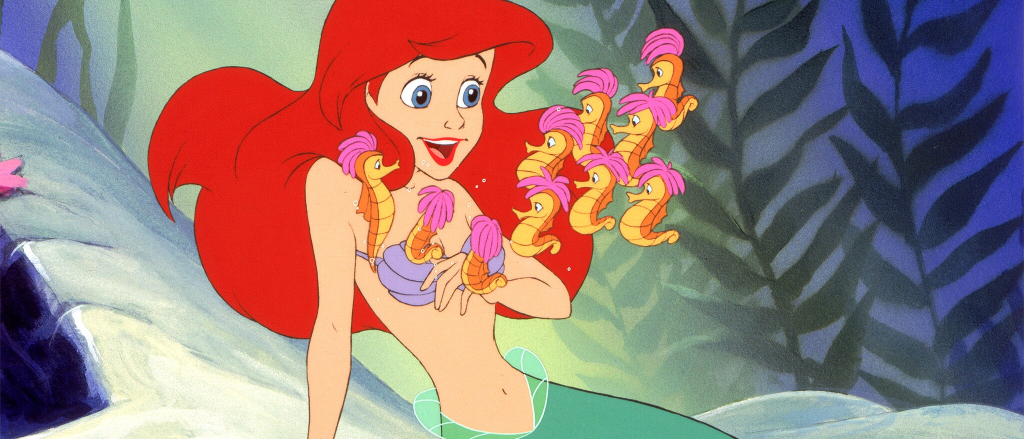
Picture from Disney Movies official website
For those who love Disney animated musicals, The Little Mermaid (1989) is a masterpiece that reinvigorated Disney’s tradition of storytelling through songs. With its unforgettable soundtrack composed by Alan Menken and lyrics by Howard Ashman, the film played a significant role in shaping the modern Disney musical formula. The Little Mermaid won two Academy Awards: Best Original Score and Best Original Song for “Under the Sea” (Heching, 2023). The musical elements in this film are highly noticed for the use of music and songs as spoken dialogues, the plot’s development, and expression of Ariel’s dream.
The Little Mermaid (1989) is a Disney animated musical film that follows Ariel, a curious and adventurous young mermaid who dreams of living on land. At first, she just loves collecting human’s things. But then, she meets, even saves, Prince Eric on land and falls in love with him. Despite warnings from her father, King Triton, she makes a deal with the sea witch Ursula to trade her voice for human legs in the hope of winning the love of Prince Eric. As Ariel navigates life on land without her voice, she must earn Eric’s love before time runs out to get her voice back, or she will belong to Ursula forever. With the help of her friends, Sebastian, Flounder, and Scuttle, Ariel fights to reclaim her voice and true identity, while still manages to win the Prince’s heart.
Songs in this film are used for spoken dialogues. First, the song “Poor Unfortunate Souls” sung by Ursula is an example on how a song is used for spoken dialogues between her and Ariel. The song can show the villain’s character and express her intentions. This song is dramatic and theatrical, featuring bold orchestration and Ursula’s powerful, almost hypnotic vocal delivery by Pat Carroll. For example, the song starts with “I admit that in the past I’ve been nasty. They weren’t kidding when they call me, well, a witch,” which acts like an introduction (to her history) in spoken dialogues between Ursula and Ariel, in the scene when Ursula is about to manipulate Ariel. The lyrics show Ursula who is trying to appear honest by admitting her past in a sarcastic and self-aware way to help Ariel lower her guard. And the continuation of the lyrics, “I’m not perfect, but I’ve changed,” successfully build Ariel’s trust in her. The repetition of “poor unfortunate souls” help emphasise the validation of what Ariel is feeling, in a very manipulative ways, by showing there are more people (or mermaids) out there who are in the same situation as hers. The lyrics, “The men up there don’t like a lot of blabbers, they think a girl who gossips is a bore. Yes, on land it’s much preferred for ladies not to say a word,” are filled with manipulative undertones, as Ursula convinces Ariel to give up her voice in exchange for legs. Also, this song is best used to represent and deliver the villain’s characterisation, as it is written very detailed.
The next example is that Sebastian’s dialogues to Ariel are replaced by singing a song. With a contrast atmosphere as the previous one, this example occurs in the song “Under the Sea.” This song not only provides comical relief but also serves as Sebastian’s persuasive argument against Ariel’s desire to leave the ocean. The lively rhythm, drums, and reggae influences create a festive atmosphere, enhancing Sebastian’s belief that the ocean is a paradise. The instruments are animated with the sea creatures but not with the actual instruments in real world, which make the sequence of the scenes truly humourous and fun. The playful lyrics, “Darling, it’s better, down where it’s wetter, take it from me,” highlight the contrast between Ariel’s romanticised view of the human world and the reality that life under the sea has its own joys. Sebastian delivers the song with a cheerful and playful tone although the seriousness of the lyrics match with Ariel’s age and mind, so that he can persuade her to stay in the ocean.
Furthermore, in this film, the instrumental music that follows every scene is essential in showing the scene’s atmosphere and storyline’s enhancement. Unlike songs with lyrics, instrumental scores rely purely on the melody, rhythm, and orchestration to express what the characters feel and what the audience should sense. A powerful example of this can be seen during the intense storm scene when Prince Eric’s ship battles the crashing waves and violent winds. The sequence is cleverly delivered with a sense of humour by bridging it with the prince’s dialogue with his royal valet, Grimsby. The prince says, “Without a doubt, it’ll just, bam, hit me, like a lightning!” Then the scene continues with a lightning being really hit his ship. This scene also represents the interconnection of how Eric can meet Ariel. Furthermore, the music that accompanies this moment builds the urgency—featuring pounding beat, fast-paced strings, and dramatic crescendos—which mirrors the rising danger and chaos of the storm. The absence of dialogue in this part of the scene allows the instrumental score to take the center stage, guiding the audience’s emotional reaction and creating tension. The sound of people shouting, a dog’s panic barking, fast-paced steps of running, heavy raining, and strokes of lightning perfectly fill the scenes’ needs. The music itself intensifies the visual stakes and draws the viewer into the life-threatening danger the characters are facing. It is truly one of the film’s cleverest uses of scoring, matching the tone of the action and enhancing the storytelling without the need for words. This moment highlights how instrumental music functions as a non-verbal narrative tool, help elevate both the scene’s mood and the overall cinematic experience.
Lastly, the main song of The Little Mermaid, “Part of Your World”, is actually shown up three times in the film, and each of them has different lyrics—but the same melody. Each time the song shows up, it functions differently according to the scenes. The songs appear in the beginning, the first half, and at the end of the film.
First, the original and full-length song of “Part of Your World” is sung in the beginning of the film by Ariel to express her feeling and dream. In the first act of the film, “Part of Your World” is used to introduce Ariel’s personal ballad, sung while she is alone in her secret grotto filled with human artifacts. The lyrics, “Look at this stuff, isn’t it neat? Wouldn’t you think my collection’s complete?” immediately present her longing and fascination with the human world. The song functions as a monologue in musical form, revealing Ariel’s dissatisfaction with her life under the sea and her deep curiosity about life beyond it. As the song progresses, she sings, “I wanna be where the people are. I wanna see, wanna see them dancing,” which directly expresses her desire to be a part of human society, not just observe it from afar. Next, the lyrics, “Up where they walk, up where they run, up where they stay all day in the sun. Wondering free, wish I could be part of that world,” clearly convey Ariel’s yearning for living her life in a world beyond the ocean. The song grows in emotional intensity, reaching its peak in the powerful last line, “Wish I could be, part of that world,” which becomes the thematic line of the film.
The second time this song shows up is when Ariel first meets Prince Eric, and she sings this song after she rescues him from a deadly storm and brings him safely to the shore. As he lies unconscious, she watches over him and softly sings a short reprise of “Part of Your World.” The same melodies appear in the lyrics, “I wanna be where the people are…,” which are changed into, “What would I give to live where you are? What would I pay to stay here beside you? What would I do to see you smiling at me?” The whole sequence of the lyrics shows clearly the change of Ariel’s dream and goal, that is not only wanting to live in human’s world, but it also becomes more and more specific. The idea of human, and everything about human that Ariel has been dreaming of, starts to develop into the idea of Prince Eric. The lyrics, “Where would we walk? Where would we run? If we could stay all day in the sun?” represent Ariel’s innocent wish. All these times, Ariel only wishes for a better live beyond the ocean, but now, she wants to live her life beyond the ocean with the man she loves. Later on in the song, she sings, “I don’t know when, I don’t know how, but I know something’s starting right now,” which express a shift in Ariel’s dream. The line, “Watch and you’ll see, someday I’ll be, part of your world,” directed to Prince Eric, holds a deeper personal meaning. It is not just about joining the human world anymore; it is about being with him. The change of ‘that world’ into ‘your world’ shows clearly that she is now no longer having a vague imagination of the world up there, but it turns into Prince Eric’s world in her mind. This song marks the beginning of her love story, and she is ready to take a risk.
In the final scene of the film, when Ariel and Eric are getting married, the song “Part of Your World” returns for a third time—this time it is sung by a choir instead of Ariel herself. The melody is instantly recognisable, but the shift in the vocal style and arrangement gives it a sense of closure and celebration. This version no longer carries the sense of longing or hopefulness; instead, it represents fulfillment and resolution. The song’s presence at the wedding symbolises that Ariel’s journey has come full circle—her dream of becoming part of the human world has come true, and she is now starting a new chapter of her life. It starts with, “Now we can walk, now we can run, now we can stay all day in the sun.” By having the choir sing the song, the film creates emotional distance between Ariel and the dream she once had—it’s no longer a private wish but a public reality. When the song ends with the lyrics, “Just you and me, and I can be part of your world,” the film ends too. With this choral version, the song transforms from a personal monologue to a shared celebration between Ariel, Prince Eric, Ariel’s father, and their people, highlighting how Ariel’s once-distant dream is now a real experience.
Despite many good things of The Little Mermaid, such as amazing songs it served, this film has one major weakness. It is a major weakness because the one who takes responsibility of this matter is the main character herself, Ariel. It is mentioned in the film that Ariel is a teenager who is currently facing puberty, and is in her unstable teenager phase. However, as the main character, Ariel’s character development is being presented poorly. She is presented as a girl who disobeys her father. She is selfish and dependent. She only wants others to understand her, while she herself cannot do the same to them. She is even being too naïve by depending her curse to be broken by Prince Eric whom she has only met once.
Overall, The Little Mermaid is one of the best Disney animated musical films in history. The songs presented in the film surely gives the audience more fun in watching the film. Not only are the songs good, but they also hold specific roles in helping the development of the storylines. The way this film uses the same melody but with different lyrics to match each scene is truly mesmerising. In this way, the audience can also feel the importance of music used in the film. Even though Ariel’s character may affect the final result of whether this film is recommended or not, it actually only leaves a small trace. For all the goods and bads that have been mentioned, The Little Mermaid still stands as one of the most recommended and popular Disney animated musical films.
References
Heching, D. (2023). ‘The Little Mermaid’ reveals first full trailer during the Oscars. CNN Entertainment. https://edition.cnn.com/2023/03/12/entertainment/little-mermaid-trailer-oscars/index.html

 Disney Animated Musical Film Reviews
Leave a comment