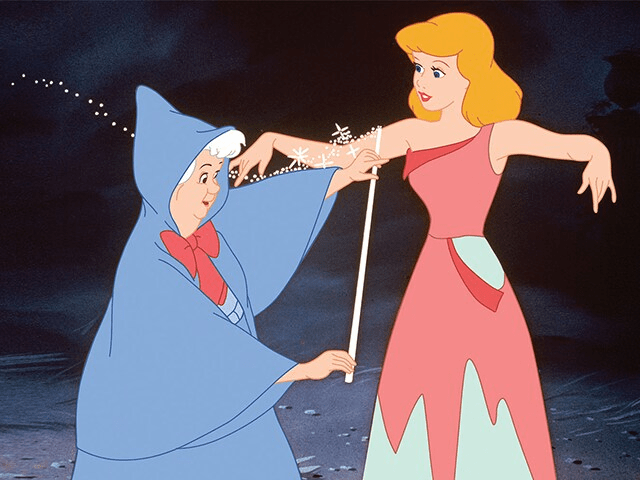
Picture from Disney Movies official website
With its music and songs, Cinderella stands as one of the Disney’s finest musical achievements. The outstanding music in Cinderella’s contributed to the film’s success. The film was nominated for several Academy Awards, including “Best Song” nomination for the song “Bibbidi-Bobbidi-Boo” and “Best Scoring of a Musical Picture” (Seastrom, 2020). Music in Cinderella is not just an aesthetic addition; it holds an important role. It is crucial in following the movement of the characters, portraying Cinderella’s emotions and inner thoughts, advancing the plot, and creating a suitable atmosphere.
Cinderella tells the story of a kind, beautiful and gentle young woman. After her father’s death, she is forced to live as a servant in her own home by her cruel stepmother and jealous stepsisters. Despite her hardships, she remains hopeful and kind-hearted. With the help of her animal friends and a magical Fairy Godmother, she is transformed for one night to attend the royal ball. That night, she captures the heart of a Prince, who holds a royal ball to find true love and get married. He is often referred to as Prince Charming. After fleeing at midnight and leaving behind a glass shoe, the Prince searches the kingdom to find her. In the end, Cinderella is reunited with him, and her life of mistreatment is replaced with happiness and love.
The film employs different musical elements, such as sound effects to serve specific role in deepening the audience’s attention. The music functions as sound effects are highly highlighted because it often appears in the film as music that follows some of the characters’ movements. For example, the sound effects are clearly presented in the sequence of the mice’s movements in the scene where Cinderella is calling everyone (all animals in the house) for breakfast. When all of the mice are running with full of excitement, they are accompanied by a happy, tingling sound effects in all their movements. And the sudden stop of music occurs when they found Lucifer, the Lady Tremaine’s cat, in front of them. This music emphasises Jaq’s, one of the mice, “uh-oh” in an entertaining way. The following swoosh sounds also accompany the next scene where the mice are panicky going back into their hole. Another example of Cinderella’s use of music as sound effects in the film are shown clearly when Cinderella hurriedly goes away from the prince after the clock bells. In this scene, it is as if the audiences also feel the nervousness of Cinderella that is currently playing tags—one chases, another runs away, with the prince and his servant. The sound effects, indeed, take a huge role in accompanying every sequence of characters’ movements in the film.
Another use of music in Cinderella is to portray her emotions and inner thinking. For example, the first song in the film, “A Dream Is a Wish Your Heart Makes”, introduces the audience to Cinderella’s character and her optimism. Sung in a soft, dreamy tone as she wakes up in the morning, the song expresses her inner thoughts: “No matter how your heart is grieving, if you keep on believing, the dream that you wish will come true.” This line perfectly describes Cinderella’s character—despite the hardships she faces, she chooses to remain hopeful. The gentle melody and soothing instruments create an intimate moment, emphasising the warmth and kindness that define her personality. More than just a song, “A Dream Is a Wish Your Heart Makes” serves as the emotional core of the film. It sets up how Cinderella believes. This song also foreshadows the film’s resolution, where her patience and beliefs ultimately lead her to happiness. Throughout the film, the melody subtly reappears in the instrumental score, reinforcing the idea that dreams and faith will eventually be rewarded.
Music in Cinderella is not limited to her own perspective—it also reflects the emotions and personalities of supporting characters. “The Work Song”, sung by Jaq, Gus, and the other mice, is a lively and energetic song that contrasts Cinderella’s earlier ballad. The fast-paced rhythm, high-pitched harmonies, and playful instrumentation (such as quick violin strokes and chattering sounds) add a sense of urgency and excitement as the mice work together to make Cinderella’s dress for the ball. The song lyrics showcases the loyalty and kindness of Cinderella’s animal friends: “We can do it, we can do it, we can help our Cinderelly!” Through this musical sequence, Disney cleverly illustrates the theme of friendship and teamwork. While Cinderella herself is powerless to escape her situations, her selflessness inspires those around her to take action. The upbeat nature of the song also helps lift the film’s tone, reminding the audience that kindness attracts support and love, even in the smallest ways.
There is a song that functions as plot’s development. It is arguably the most iconic song from Cinderella, “Bibbidi-Bobbidi-Boo” introduces the Fairy Godmother and her amazing powers. Unlike the previous songs, which are grounded in emotion or character development, this song is all about transformation—both literally and figuratively. The whimsical melody, combined with nonsense lyrics, mirrors the unpredictability of magic: “Salagadoola mechicka boola, bibbidi-bobbidi-boo!” The song’s bouncy, irregular rhythm and playful instrumentation (such as bells, strings, and flourishes of woodwinds) emphasise the idea that magic in Cinderella’s world is spontaneous and joyful. As the Fairy Godmother sings, everyday objects—pumpkins, mice, and rags—are turned into grand elements of Cinderella’s fairytale dream. Beyond its function as a fun and memorable tune, “Bibbidi-Bobbidi-Boo” also symbolises a turning point in the story. For the first time, Cinderella experiences the possibility of her dream coming true. The song captures the essence of wish fulfillment, reinforcing the film’s theme that magic happens when you believe, and when you do not stop believing.
The royal ball sequence is where Cinderella fully embraces the classic Disney tradition of using songs instead of dialogues to create the most suitable atmosphere. The song, “So This is Love,” is performed as Cinderella and Prince Charming share their first dance, marking the moment they fall in love. The instrumentation is soft and flowing, with strings and gentle piano chords creating an ethereal atmosphere. The lyrics themselves are minimal, focusing on the idea that love is not something that needs to be spoken—it is something that is simply felt. The song’s role in the film is crucial. It transforms Cinderella’s dream into reality, as she realises that love exists beyond her imagination. The duet between Cinderella and the Prince also sets an example of how music becomes the primary media for expressing romantic atmosphere.
Despite its status as a beloved fairy-tale, Cinderella has several weaknesses. The story heavily relies on the “damsel in distress” trope, portraying Cinderella as a passive character whose problems are ultimately solved by external magic and a prince, rather than her own actions. This can make her character feel underdeveloped and dependent. Additionally, the film’s side characters—particularly the mice—receive a significant amount of screen time, sometimes overshadowing Cinderella herself and shifting focus away from the main plot. The stepmother and stepsisters are also portrayed as one-dimensional villains without any backstory, which limits the emotional complexity of the conflict. Lastly, the film’s simplicity and traditional gender roles reflect the era in which it was made, and may not fully resonate with the modern era. In traditional western gender roles, women’s happiness was often linked to marriage and domesticity (Dremo, 2023). Although the traditional gender roles in this film are presented implicitly, they are still noticeable. For example, Cinderella’s life changes not through her own effort, but it changes because she is chosen to marry the Prince. It represents the idea that a woman’s ultimate happiness comes from marriage to a powerful man.
All in all, Cinderella is a remarkable example of Disney’s early success in combining animation with powerful musical elements. The film uses music not only to enhance the emotional depth of the characters, especially Cinderella herself, but also to advance the plot and create memorable, magical moments. Songs like “So This Is Love” and “Bibbidi-Bobbidi-Boo” have become iconic, showcasing how music can reflect characters’ world and transform ordinary scenes into something extraordinary. With its charming visuals, soundtrack, and timeless themes of hope and kindness, Cinderella continues to stand as a classic in Disney’s musical film history. Despite some outdated themes and character portrayals, Cinderella is still recommended for those who appreciate classic animation and musical. Its emotional music, memorable characters, and fairy-tale narrative make it suitable for both children and adults.
References
Seastrom, L. (2020). The history, debut, and impact of Disney’s classic Cinderella. The Walt Disney Family Museum. https://www.waltdisney.org/blog/history-debut-and-impact-disneys-classic-cinderella Dremo, M. (2023). Differences in gender role beliefs among Eastern and Western European women and their relationship to well-being [Bachelor’s thesis, University of Twente]. University of Twente. https://essay.utwente.nl/95243/1/Dremo_BA_BMS.pdf

 Disney Animated Musical Film Reviews
Leave a comment