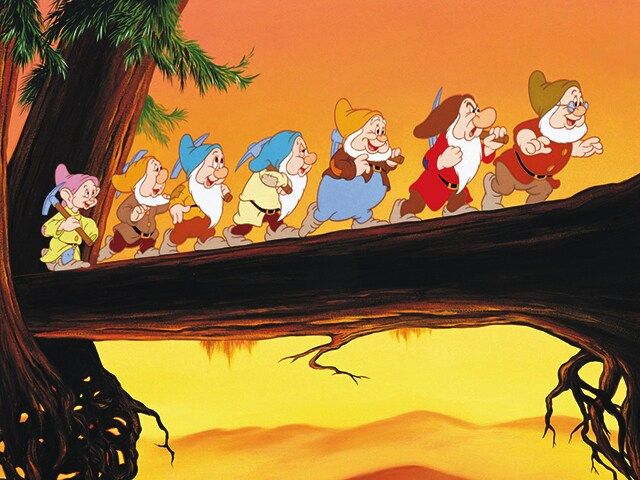
Picture from Disney Movies official website
Upon its release, Snow White and the Seven Dwarfs (1937) was getting a bunch of positive attention from film enthusiasts. Quoting from what happened in 1938, The Academy Award honoured Snow White as “a significant screen innovation which has charmed millions and pioneered a great new entertainment field for the motion picture cartoon” (Bertolaccini, 2023). Snow White was also nominated for Best Musical Score at the Academy Awards in 1938 (Bertolaccini, 2023). Snow White and the Seven Dwarfs bravely introduced an uncommon film genre by encouraging its cartoonish animation with the use of musical elements, such as instrumental music to be used as background music and classical songs to express dialogues in singing and enrich the storylines. These make Snow White such a memorable film released by Disney of all time.
Snow White, a kind-hearted princess, is forced to work as a servant by her jealous stepmother, the Evil Queen, who becomes enraged when her Magic Mirror declares Snow White the fairest of them all. The Queen orders a huntsman to kill Snow White. But she manages to escape into the forest, meets the kind animals, and stays in the Dwarfs’ cottage. Snow White is tricked by the disguised Queen into eating a poisoned apple, falling into a deep sleep. Believed to be dead, she is placed in a glass coffin by the grieving dwarfs until a prince, awakens her with true love’s kiss.
In Snow White, music is always there from the very beginning until the end of the film. That is why, music certainly plays a crucial role in this film. Most importantly, it is because a film score essentially consists of musical elements, including melodies, harmonies, rhythms, instrumentation, and dynamics (Scorecraft Academy, 2023). These elements’ roles include setting the mood and helping audience understand the story. Furthermore, songs in musical films function similarly with the spoken dialogue of the narrative structure and can also function as essential elements of the important narrative elements (Plemenitas, 2016).
The first musical element used in Snow White is the instrumental music. It works as the background music (BGM) of the film and as a company for sound effects. The purpose of the instrumental music is to never let any scene in the Snow White and the Seven Dwarfs be in an awkward silence even a second. Other than that, the music is also purposefully used to emphasise the emotions delivery in every scene and to accompany characters’ movement. For example, in the beginning of the film, where the film shows Snow White for the first time, the scenes are followed by a soothing sound effect. The sound effects combine together of Snow White’s humming, water splashing, and birds chirping to make a perfect combination for a calm, peaceful, relaxing atmosphere. It is, on the other hand, a very different situation with the scene near the end of the film. For example, where the evil queen runs her dear life away from the dwarfs and animals that are chasing her after she poisoned Snow White, the mood felt by the BGM gives a terribly thrilling atmosphere. A very chaotic moment can be felt by the audience. The sequence starts with the queen’s evil laugh followed by a horrible thunder, a sudden heavy rain, and lightning strikes all over the frames. Those combined together successfully make the audiences watch the scene by their held-up breath, tensed body, and fast paced heartbeat. These examples validate that the instrumental music in the film is essential. The audience can feel the ups and downs of the emotions in every scene better.
In old musical films, spoken dialogues are often expressed by singing a song. The same case is applied in Snow White. The songs included in this film are not simply just a combination of music, instruments, and lyrics. The songs are often started by a simple dialogue that will lead to the character singing. For example, Snow White uses songs to deliver spoken dialogues of the prince to Snow White. In the beginning of the film, Snow White is singing by herself with the birds as her audience. Suddenly, another voice of a guy, the prince, joins her and gets her frightened. The prince that follows Snow White who is trying to run away and get inside the castle, starts delivering his dialogues in melody. He sings, “Now that I’ve found you, hear what I have to say…” Even though the line states the word ‘say’, he continues saying his purpose by singing instead. The song feels very pure because it delivers emotions by making the characters sing their dialogues without so many instruments. It is very entertaining to watch the classical musical film like Snow White.
Moving on, some of the songs in Snow White are used to make the predictable and childish plot more interesting to watch by making an interconnection of one song with another. For example, there definitely is a connection between the song “I’m Wishing” sung by Snow White and “One Song” sung by the prince. The statement “If the wish made into the wishing well and it is echoing, it is secretly told that the wish will soon come true” is mentioned by Snow White herself in her song “I’m Wishing” and she really believes it. In “I’m Wishing”, Snow White wishes, “I’m wishing for the one I love to find me today. I’m hoping of the nice things you say.” In the film, after she speaks her wishes into the wishing well, she hears it echo, which means her wish will soon come true. That is why, there is a connection between “I’m Wishing” and “One Song”, which is a wish and its answer. Snow White’s wish is given the answer shown by the lyrics in “One Song”. The prince sings, “Now that I’ve found you, hear what I have to say. One song, I have but one song. One song, only for you. One heart, tenderly beating. Ever entreating, constant and true.” Not too long after Snow White wishes, she is then found by the one she loves, the prince, and that the prince says the nicest things for her to hear. The reason why one song to another can be interconnected in Snow White is because the songs are mostly not written as a whole song. Instead, the songs are just spoken dialogues being sung.
Despite the fact that Snow White opens the gate for full-length animated musicals in the film industry, this film has a weakness that can be noted for future works with similar genre. The film has a too predictable plot and it is rather confusing. It seems like the entire film only goes like a short bed time story. At the beginning, the pacing is quite fast. But in the middle, the pacing is rather slow and repetitive. It is also noticeable that the target audience for this film is younger children. But in the scene where the film shows the Evil Queen’s terror to Snow White in the forest may appear too disturbing for children. Lastly, the character development of the main character, Snow White, is not quite remarkable, as she always needs her surroundings to help her develop. All that she can do is wishing.
Nonetheless, Snow White and the Seven Dwarfs paves the way for all future Disney animated films, proving that animation and musical could be a powerful storytelling medium. This film successfully introduces the genre of animated musical in a very attractive way. It also includes the musical elements cleverly in the film, such as instrumental music and songs. Although the plot may seem too childish for older kids and grown-ups, this film still serves as a good romance-fantasy film for little children because this film is entertaining in many ways. One of the film’s influences can be seen in countless animated films that followed, and its characters have remained dominant in Disney’s legacy. From theme park attractions to merchandise, Snow White’s impact on pop culture is undeniable.
All in all, Snow White and the Seven Dwarfs is a masterpiece that continues to hold its magic even after nearly a century. With its captivating animation, heartfelt story, and unforgettable music, the film remains a timeless classic. Whether you are a lifelong Disney fan or watching it for the first time, this film is a masterpiece of animation history that should not be missed. It is indeed recommended for a one time watching, but not for countless times rewatching, because the storyline is too simple and could be too boring.
References
Bertolaccini, B. (2023). Snow White and the Seven Dwarfs honorary academy award. The Walt Disney Family Museum. https://www.waltdisney.org/blog/snow-white-and-seven-dwarfs-honorary-academy-awardr
Mike. (2023). What are the elements of a film score?. Scorecraft Academy. https://scorecraftacademy.com/what-are-the-elements-of-a-film-score/
Plemenitas, Katja. (2016). Songs as elements in the generic structure of film musicals. ELOPE: English Language Overseas Perspectives and Enquiries, 13(1). https://doi.org/10.4312/elope.13.1.31-38

 Disney Animated Musical Film Reviews
Leave a comment