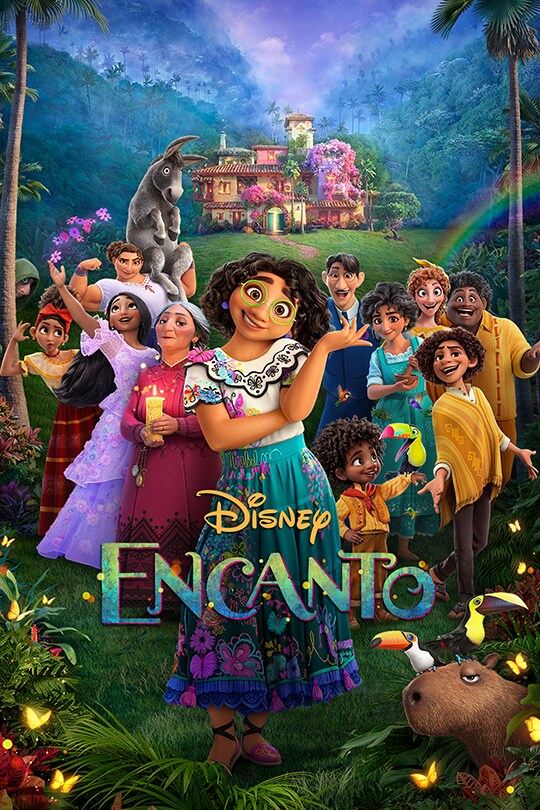
Picture from Disney Movies official website
Encanto is the new comer of a family and cultural themed animated musical film from Disney after it released Coco in 2017. This film is considered as a big success because it achieved the total of 58 wins and 89 nominations, including three wins at the 2023 GRAMMYs for Best Compilation Soundtrack, Best Score Soundtrack, and most amazingly, Best Song Written for Visual Media for the song “We Don’t Talk About Bruno” (Lipsky, 2023). The musical elements in Encanto are essential in showing the characterisation of Bruno, expressing Mirabel’s, Luisa’s, and Isabela’s feelings and inner thoughts, replacing spoken dialogues between characters, and emphasising a sequence of scenes in the film.
Encanto tells the story of the Madrigal family, who live in a magical house in a Colombian village. Each family member has been granted a unique magical gift—Isabela can grow flowers, Luisa is extremely strong, Julieta heals with her food, and any other characters’ gifts—except for Mirabel, the only one without powers. On the day when her youngest cousin, Antonio, is about to receive his gift, Mirabel finds out through Bruno—her uncle whose gift is to be able to see the future—that she may be the cause of the family’s downfall. Through her journey of trying to keep the magic in the family alive, she discovers the importance of love, acceptance, and embracing one’s true self, proving that she might be the key to her family’s magic all along.
One of the songs in Encanto is used to show the characterisation of a character, that is, Bruno. According to Littel (2008, p. 178), one of the four methods of characterisation is through other characters’ reaction to a character: what others say about the character and how they treat him or her. In this film, this method is used in one of the most iconic songs in Encanto, “We Don’t Talk About Bruno”, to define his character. The song is sung by several characters, including Pepa, Dolores, Camilo, the villagers, and other family members. The first highlighted part is Pepa’s lines in the song, that is “Bruno says, it looks like rain, in doing so, he floods my brain.” Pepa is the one who can control the weather according to her emotions, and Bruno says something that messes up her mind causing her wedding day to be in chaos. Pepa describes Bruno as an evil because she thinks that Bruno tells her about the rain intentionally to ruin her wedding. The lines, “Bruno, live in fear of Bruno stuttering or stumbling. I could always hear him sort of muttering and mumbling. I associate him with the sound of falling sand,” sung by Dolores, who has superhuman hearing ability, show her thoughts of Bruno and slightly reveal that she knows Bruno has never left. She just thinks that Bruno is someone who carries a heavy gift everyone hates and cannot understand. The song continues with the lines from Camilo, the one who can shape-shifting, “Seven-foot frame. Rats along his back. When he calls your name, it’s all fades to black.” He performed his lines while also mimicking how Bruno uses his gift. The lines he sings also show how he, as a young family member, sees Bruno, an adult, who is doing a vision and get scared of him. Aside from the family members, there are also other characters, the villagers, who speak up about Bruno. They say, “He told me my fish would die, the next day dead / He told me I’d grow a gut, and just like he said / He said that all my hair would disappear, now look at my head.” The whole song is intended to describe the characterisation of Bruno through other characters’ opinions of him, and the result is everyone is scared of him to the point where they do not want to talk about Bruno.
Songs in the film are also used to express the feelings and inner thoughts of the siblings: Mirabel, Luisa, and Isabela. For Mirabel, the song used to describe her emotions is “Waiting on A Miracle”. The lyrics she sings in the song explains how she has been feeling all those times. She feels that she is no longer part of the Madrigals as she is the only one who does not have a gift. The song tells how Mirabel often suppresses her feeling and convinces herself that she is fine with everything happening in the family when she is actually not. Through this song, the audience can also feel how insecure Mirabel is compared to the other family members.
The next one is “Surface Pressure” sung by Luisa, Mirabel’s big sister whose gift is superhuman power. In this song, Luisa expresses her feelings on how she is seen by the others versus her real self. She is pressured to show only how she can handle anything on the surface. The lyrics, “Who am I if I can’t run with the ball? / Who am I if I can’t carry it all?” show that even an extremely strong lady like her can also feel insecure and scared to disappoint others. All these times, Luisa thinks that she is only labelled as a strong one. She thinks that she cannot show anyone any of her weaknesses that lie under the surface.
The last song used to express a character’s feelings and thoughts occur in the song “What Else Can I Do?” by Isabela. In this song, she expresses her shock to the fact that she can grow other plants, a cactus, besides flowers. She starts to feel more eager to find more things she can do with her gift. She also uses this chance to finally open up to Mirabel about how she feels; she feels burdened by the image to be always perfect and to have to obey at any cost. She wonders if she can use her gift by following her emotion at the moment, if she can be her true self. She wonders about living the life where she does not need to be perfect.
Encanto serves like a Broadway musical because of its clever use of song as the replacement of spoken dialogues between the characters in the song “All of You”. The song starts with Mirabel speaking to her family by singing the lyrics, “Look at this home, we need a new foundation.”The first person to join the conversation is Abuela Alma, with her lines, “And I’m sorry I held on too tight just so afraid I’d lose you too,” to apologise to the family members about how she has been acting all those times by also giving a reason behind her actions. After some touching lines about the family members themselves are the miracle itself, Camilo joins in with his witty lines, “Okay, so we gonna talk about Bruno?” which the lyrics also take a reference from the song “We Don’t Talk About Bruno”. After that, the Bruno himself replies with, “Yeah, there’s a lot to say about Bruno. I’ll start, okay…”Then the song proceeds to show tiki-taka of the dialogues between the Madrigals in a Broadway musical way which adds more fun to watch and listen to.
Lastly, the instrumental music that follows the sound effects in this film is also very important in emphasising the atmosphere of every sequence of scenes in the film. One of the most noticeable examples of this is in the heart-wrenching sequence when the Casita, the magical home that has sheltered and symbolised the Madrigal family’s strength for generations, begins to collapse. The scene begins with a subtle breaking sound that can only be heard by Mirabel. Then, the sound of tiles cracking starts to join in. And as the damage worsens, the music grows louder and more intense. The instrumental music help create suspense in the current happening events. The Casita that was first introduced as a cheerful, responsive, and welcoming home, turns into a cold one after the crack happened. The atmosphere becomes even more chaotic when the people in the film also start running here and there. One is busy running away from the fallen Casita, another one is busy reaching for the magic candle that keeps the family alive. The whole sequence of these scenes represents not only a house breaking, but also a family—who lives in the house—falls apart.
Although some parts of the film serve as good examples that can help audiences who are not Colombians understand a little more about their culture, some other parts still have weaknesses. First, the Colombians’ culture about specific genders holds specific roles shown in the film are quite stereotypical. The film did some stereotyping in giving roles along with the appearances of the characters. For example, Isabela is born pretty and grown as a perfect girl whose problem is only not being able to show her imperfect sides. It is an unfair case compared to what Luisa’s, Bruno’s, and even Mirabel’s problems. The problems they face are complicated. They have problems which include their own feelings, others’ expectations, and the need to fit in the family’s standard. For example, Mirabel often repeats the phrase “make your family proud”. This phrase shows that some of the Madrigals, like Luisa, Bruno, and Mirabel, live for the sake of their family name, and that no matter how hard they try to fit in the family, they could never satisfy Abuela Alma. Another weakness is that the conflict this film brings up is not so well-presented. For example, the family members, especially Abuela Alma, treats Isabela so well because she is pretty, and she has a beautiful gift too. It is very different from how she treats Mirabel and Bruno. Both of them are treated unfairly and harshly just because one of them, Bruno, has a gift he did not choose and another one, Mirabel, did not receive any gift. Both of their problems are something that is out of their hands as they are not the one who is in control. Lastly, this leads to the dissatisfaction of when Mirabel and Bruno forgive Abuela too fast considering how cruel Abuela has been treating them. This film’s ending ends up to be unrealistic due to forcing the family-themed ending.
In Encanto, music and sound are essential in revealing characters’ inner feelings, advancing the plot, and highlighting emotional turning points. The film effectively uses its musical elements to bring depth to characters like Mirabel, Luisa, and Isabela, while also replacing traditional dialogue with engaging lyrical exchanges. Instrumental music and sound effects further enhance the emotional atmosphere of each scene, especially during key moments like the collapse of Casita. While Encanto successfully showcases Colombian culture in some aspects, such as family unity, it falls short in portraying certain cultural values—particularly in the depiction of family dynamics and gender roles. Despite this, the film remains a musically rich and emotionally touching story that delivers a strong message about identity, acceptance, and the unseen strengths within each individual.
Overall, Encanto is a good family-themed animated musical film produced by Disney. But if it needs to be compared with the other film within the same theme like Coco, it still lacks some parts, such as cultural representation and plot development. However, Encanto has all the memorable and catchy soundtracks, especially for “We Don’t Talk About Bruno”. For all the strengths and weaknesses this film has, it is safe to say that Encanto stands as another must-watch Disney animated musical films.
References
Lipsky, J. (2023). 'Encanto' sweeps the 2023 GRAMMYs: Disney's animated smash wins 3 categories. Grammy. https://www.grammy.com/news/encanto-sweeps-2023-grammys-visual-media-categories-we-dont-talk-about-bruno-lin-manuel-miranda-germaine-franco
Littell, M. (2008). Literature: Student edition grade 7. MCDOUGAL LITTELL.

 Disney Animated Musical Film Reviews
Leave a comment